I found an article called "Teacher to Teacher." While I would recommend the whole article and every chapter in it, I focused on one particular chapter. The chapter I focused on was Chapter 1 entitled, "Recognizing Words." This chapter appealed to me the most because I am very interested in teaching Kindergarten, and I have often wondered what the best methods are to teach sight words. As we have read, phonological awareness is one of the strongest indicators of a child's word-recognition ability. This is a hard process for five and six year olds, since they have to link what they are hearing or reading to the way they understand the spoken language. When a child puts together simple rhymes, understands that one-syllable words have two parts, and recognizes word patters, this will be a true measure of how well they can read.
It is important for instruction to start with words that a child identifies to. Then, implementing sight words that are used frequently within the text should be implemented. Teaching high-frequency words and high-interests words in a specific text, or words that children don't have the ability to decode yet in this order, will be more beneficial for a child to structure meaning and learn more successfully.
Here are some activities a teacher can do to teach word recognition:
WHERE THERE'S A WORD, THERE'S A VOWEL
In this activity, the teacher needs to cut out all the letters of the alphabet, except for the vowels. Ask the students to try to write as many words as they can using the letters. They will soon realize that they can't, and ask for vowels. They will understand that a word cannot be written without anyone of the vowels. The next day, write a sentence on the board, and cross out where the vowels should be. Ask the students to critically think about what vowel goes in each space.
ACTION PHONICS
In this activity, a teacher for example writes the word "march" on one side of the card, and the letter m on the back side of the card. After having the children march around the room, show them the card. They will realize that the written word "march" means to march, and the letter "m" is the first letter of "march." Tell help them realize what the letter m sounds like, tell them to march whenever they see the letter m.
SPICING UP VOCABULARY STUDY AND REVIEW
Memory experts recommend that it is important to attach a memorable aspect when trying to remember anything. If you are trying to teach your students vocabulary words that revolve around a specific story, have your notecards cut out into the specific shape that represents that word. For example, if you are trying to teach words that involve the ocean, cut out flash-cards out in a palm tree or fish shape.
PRACTICING HIGH-FREQUENCY WORDS WITH REBUS STORIES
Always take advantage of art projects when they can be incorporated. They highly motivate younger children. Here is the steps in this activity:
1) Create a rebus story using words from high-frequency words list, but don't draw the pictures.
2) Type the story, triple spacing between the lines so that ample space remains from the rebus pictures.
3)Have each child create the stories by drawing whatever they choose in the blank spaces.
4) Have each child read his/her story to a classmate
5) Compile a book of the children's rebus stories for the class library.
Sunday, March 25, 2012

Monday, March 12, 2012
Value your Vocabulary
While reading the different articles for vocabulary, I kept referring back to a story that one of my teachers told my class this past semester. One of her Roane County interns was in a second grade class and asked them to describe the beach, draw a picture, and write sentences under it. The children described a concrete black top, river, and trees. Their definition of a beach was much different than what the teacher had in mind. In that county, there is an area where families would go play and hang out on the weekends. They called this place "the beach."I thought this was a pretty good example of how diverse peoples vocabulary is. It goes back to the question from our reading, "what does it mean to know a word?" Whether it is right or wrong, it is important for teachers to allow his or her students to discover meaning of words through context clues, visual exercises, research, and reading. Students learn from indirect instruction, rather than direct teaching of vocabulary words. I wish my teachers had a better understanding of this when I was in grade school, middle, and high school. At my school, we had a vocabulary book where we filled in sentences, and wrote paragraphs using the vocabulary words. At the end of the week we had a quiz over all fifteen vocabulary words. If someone were to ask me to define those words the next week it was highly unlikely that I could be capable of doing that. Cunningham and Allington give great tips on how to incorporate meaning behind words through discovery. Drawing pictures of words, alphabet books, and letting the child discover words they want to discuss is a great way to promote critical thinking and comprehension as well.
While using manipulative and visual objects are helpful, it is important for us to use our technological resources as well. Online vocabulary games are a great way to get students engaged. I thought a great activity that we did in class was coming up with enough words as possible with the letters provided. It is so important for teachers to be word conscious teachers. This requires that we develop an awareness of the times when vocabulary instruction and discovery can be used in the classroom. How were you taught vocabulary as a child?
While using manipulative and visual objects are helpful, it is important for us to use our technological resources as well. Online vocabulary games are a great way to get students engaged. I thought a great activity that we did in class was coming up with enough words as possible with the letters provided. It is so important for teachers to be word conscious teachers. This requires that we develop an awareness of the times when vocabulary instruction and discovery can be used in the classroom. How were you taught vocabulary as a child?
Sunday, March 4, 2012
Comprehension for Youngsters!
The three things that effect comprehension are "the reader, the text, an the purpose." The two articles that I read were Gill's, "Reading Teacher" and Gregory's "Kindergarteners can do it too! Comprehension strategies for early readers." Through both of these articles it is clear that comprehension is a process. It is so important for a child to be able to relate, ask questions, and formulate opinions about what they are reading. All of these things can be done through familiarity. In Gill's reading, the children would have "I wonders" about the story that would occur before, during, and after the reading. This was a way to connect what the students thought about to their personal, text, and world view. Just like Mrs. Hope used poems to help students understand and make sense of the text, Gill suggested that a good teacher gives sufficient information regarding readings. Giving students meaning of vocab words, context clues, and basically setting them up for success will greatly help their comprehension techniques. Asking students questions before a story that make it seem relative is crucial, especially for young children. I chose to read these two articles because I am very interested in teaching kindergarten. The techniques Mrs. Hope used in the classroom was very comparable to what I am seeing in fourth grade classrooms now. She is requiring that the children be creative, ask questions, draw conclusions off of what they have read and their questioning, and categorize connections that they drew. There were so many different parallel lines that could be drawn from both of these readings. Gill's article is something that should be used for every grade level, and Gregory's article only further solidifying the beneficial techniques that Gill offered in his article.


Monday, February 27, 2012
Carefully Creating Words
Reading these two articles, "Ten Important Words Plus: A Strategy for Building Word Knowledge," and "Making Words: Enhancing the invented spelling-decoding connection," made me think of how greatly this would of benefited me had I been immersed in these activities as a child. Growing up, I was not a fantastic speller, and it was always brought to my attention, especially in second grade how I needed to improve. I was trying my best to spell what sounded right to me. Had my teacher allowed us to create words using the a certain number of letters given to us, I would a. had fun, b. critically think about what words could be made out of specific letters, and c. remembered my mistakes. I think people learn how not make the same mistake twice through remembering what they did during a tangible and memorable activity.
Not only did I like manipulating cards to create different words, but I also like the idea of circling ten words that students found most valuable in the paragraph. I think it provides vocabulary awareness, past and present, and helps a child learn what context clues are. I thought it was a great idea to have different questions for different students after they read the passage to facilitate their critical thinking skills. These two articles made me reflect on what methods my teachers used to teach us words and their meanings. How did your teacher go about teaching you what words were and how they were important?


Not only did I like manipulating cards to create different words, but I also like the idea of circling ten words that students found most valuable in the paragraph. I think it provides vocabulary awareness, past and present, and helps a child learn what context clues are. I thought it was a great idea to have different questions for different students after they read the passage to facilitate their critical thinking skills. These two articles made me reflect on what methods my teachers used to teach us words and their meanings. How did your teacher go about teaching you what words were and how they were important?


Monday, February 20, 2012
Fun with Phonics and Spelling Patterns
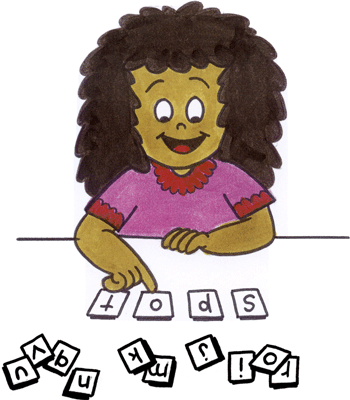
This quote stuck out to me from the book, "English is the most morphologically complex language. Linguists estimate that for every word you know, you can figure out how to decode, spell, and build meanings for six or seven other words, if you recognize and use the morphemic patterns in words. This should make our jobs easier as teachers, because many English language words, already have words inside of them. For example, discovery, has the word discover in it. When I read this, it struck me how little I see phonemic awareness activities in classrooms. I am currently in a fourth grade class, and I doubt that these students would be able to define a word by the previous skill I mentioned. As the article, "Supporting phonemic awareness development in the classroom" said, phonemic awareness activities should only be ten to thirty minutes. It is our responsibility as teachers to show them rhyming schemes, counting syllables, and to separate the beginning of a word from its ending, and lastly to help them identify each phoneme inside a word. These skills should be used to help children figure out meanings and relatedness of words in every subject, not just writing. An activity that I really liked involved cuing. It helps if student clap out the different syllables in a word. This oral and physical representation of different syllables helps with rhyming and the flow of the word. Also, telling stories that have a lot of rhyming patterns would be beneficial. Integrating the clapping of the hands would also help and make phonemic awareness more concrete.

Monday, February 13, 2012
Teaching Fluency!!
After reading the two articles and chapter four, I realized that there is SO much we can do for a child to help better develop their fluency skills and confidence. Because there was so much covered in the three readings, I wanted to pick out two of my favorite things that I took away from the readings. The first was the word wall. There are so many different things that a students can take away from a word wall. Word wall teaches high-frequency words, spelling, interactive activities, and serves as a reminder for all students. I loved the idea of chanting and writing the words. Yelling out, "where. w h e r e. where!" is a good way to learn how to spell and become familiar with that word. To me, fluency seemed like familiarity with words. I know that familiarity is how I really learned how to read. Like the articles, re-reading books and picking something that you are familiar with is not a bad way of helping a child progress to the next level.
The second thing that I took away, and want to use in my classroom is to pick out interesting books and assign reading parts to each students; almost like a play. I think that this type of involvement in the classroom is essential. Hopefully, it will increase each child's awareness of what they are struggling with. If there are ever problems that arise for a child reading the text, I think it would be wise to use that time and reflect on why it was so difficult and what ways that "we" as a class could remember to help us next time we come across that word.


The second thing that I took away, and want to use in my classroom is to pick out interesting books and assign reading parts to each students; almost like a play. I think that this type of involvement in the classroom is essential. Hopefully, it will increase each child's awareness of what they are struggling with. If there are ever problems that arise for a child reading the text, I think it would be wise to use that time and reflect on why it was so difficult and what ways that "we" as a class could remember to help us next time we come across that word.


Saturday, February 4, 2012
Letting Go of "Letter of the Week" & IRA NAEYC postition paper
I thought that it was cool in how easily it was to relate these two article, because the IRA and NAEYC position paper gave definitions to the practices in the article "Letting Go of Letter of the Week." I really enjoyed reading, "Letting Go of Letter of the Week," because it put into perspective just how difficult being a first year teacher will be, and the level of responsibility that will be placed upon me. The article also reminded me that there is always room for improvement, and there is not one solid solution for each problem. I appreciated that Donna Bell and Donna Jarvis saw there students as readers and writers before they walked into the classroom. And it is true! A child can see a "McDonalds" bag and know it says "McDonalds." They learned that it was "McDonalds" through word recognition and familiarity. They had a basic understanding of the concepts of literacy and its function. Just like they read "McDonalds," they also knew that it meant a burger or fries.
 As "IRA NAEYC position paper," said, "birth until age 8 are most important for reading. These articles really gave me great ideas on strategies that will help my future students reading abilities. Building confidence, relating letters to other childrens names, writing letters, reflecting on work, and testing them in a way in which they can understand such as the example with Pedro, will have a lasting affect. Letting each child write how they know how to write will build their confidence. The lack of confidence can start from an early age and can lasts until the end of someones life if they are not exposed to fun and encouraging activities that get their brain activated. Writing is not easy, but creating opportunities where each child can relate, grow, and be challenged will create great writers like the children in Mrs. Jarvis and Mrs. Bells class.
In the position paper, they gave recommendations on how to better help children at certain ages in their reading and writing. When reading those, it was hard to think of examples that would be beneficial, and most importantly challenging. After reading those, I reverted back to Donna Bell and Donna Jarvis, and realized that incorporating writing into daily activities, and making reading tangible for each child will be create a supportive environment for reading and writing.
http://www.youtube.com/watch?v=q30BdJm3Eeg
In the position paper, they gave recommendations on how to better help children at certain ages in their reading and writing. When reading those, it was hard to think of examples that would be beneficial, and most importantly challenging. After reading those, I reverted back to Donna Bell and Donna Jarvis, and realized that incorporating writing into daily activities, and making reading tangible for each child will be create a supportive environment for reading and writing.
http://www.youtube.com/watch?v=q30BdJm3Eeg
Subscribe to:
Posts (Atom)