Monday, February 27, 2012

Carefully Creating Words

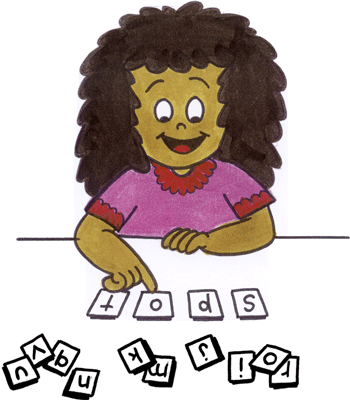
Reading these two articles, "Ten Important Words Plus: A Strategy for Building Word Knowledge," and "Making Words: Enhancing the invented spelling-decoding connection," made me think of how greatly this would of benefited me had I been immersed in these activities as a child. Growing up, I was not a fantastic speller, and it was always brought to my attention, especially in second grade how I needed to improve. I was trying my best to spell what sounded right to me. Had my teacher allowed us to create words using the a certain number of letters given to us, I would a. had fun, b. critically think about what words could be made out of specific letters, and c. remembered my mistakes. I think people learn how not make the same mistake twice through remembering what they did during a tangible and memorable activity.
Not only did I like manipulating cards to create different words, but I also like the idea of circling ten words that students found most valuable in the paragraph. I think it provides vocabulary awareness, past and present, and helps a child learn what context clues are. I thought it was a great idea to have different questions for different students after they read the passage to facilitate their critical thinking skills. These two articles made me reflect on what methods my teachers used to teach us words and their meanings. How did your teacher go about teaching you what words were and how they were important?


Monday, February 20, 2012

Fun with Phonics and Spelling Patterns

    This quote stuck out to me from the book, "English is the most morphologically complex language. Linguists estimate that for every word you know, you can figure out how to decode, spell, and build meanings for six or seven other words, if you recognize and use the morphemic patterns in words. This should make our jobs easier as teachers, because many English language words, already have words inside of them. For example, discovery, has the word discover in it. When I read this, it struck me how little I see phonemic awareness activities in classrooms. I am currently in a fourth grade class, and I doubt that these students would be able to define a word by the previous skill I mentioned. As the article, "Supporting phonemic awareness development in the classroom" said, phonemic awareness activities should only be ten to thirty minutes. It is our responsibility as teachers to show them rhyming schemes, counting syllables, and to separate the beginning of a word from its ending, and lastly to help them identify each phoneme inside a word. These skills should be used to help children figure out meanings and relatedness of words in every subject, not just writing. An activity that I really liked involved cuing. It helps if student clap out the different syllables in a word. This oral and physical representation of different syllables helps with rhyming and the flow of the word. Also, telling stories that have a lot of rhyming patterns would be beneficial. Integrating the clapping of the hands would also help and make phonemic awareness more concrete.


Monday, February 13, 2012

Teaching Fluency!!

   After reading the two articles and chapter four, I realized that there is SO much we can do for a child to help better develop their fluency skills and confidence. Because there was so much covered in the three readings, I wanted to pick out two of my favorite things that I took away from the readings. The first was the word wall. There are so many different things that a students can take away from a word wall. Word wall teaches high-frequency words, spelling, interactive activities, and serves as a reminder for all students. I loved the idea of chanting and writing the words. Yelling out, "where. w h e r e. where!" is a good way to learn how to spell and become familiar with that word. To me, fluency seemed like familiarity with words. I know that familiarity is how I really learned how to read. Like the articles, re-reading books and picking something that you are familiar with is not a bad way of helping a child progress to the next level.
   The second thing that I took away, and want to use in my classroom is to pick out interesting books and assign reading parts to each students; almost like a play. I think that this type of involvement in the classroom is essential. Hopefully, it will increase each child's awareness of what they are struggling with. If there are ever problems that arise for a child reading the text,  I think it would be wise to use that time and reflect on why it was so difficult and what ways that "we" as a class could remember to help us next time we come across that word.


Saturday, February 4, 2012

Letting Go of "Letter of the Week" & IRA NAEYC postition paper

    I thought that it was cool in how easily it was to relate these two article, because the IRA and NAEYC position paper gave definitions to the practices in the article "Letting Go of Letter of the Week." I really enjoyed reading, "Letting Go of Letter of the Week," because it put into perspective  just how difficult being a first year teacher will be, and the level of responsibility that will be placed upon me. The article also reminded me that there is always room for improvement, and there is not one solid solution for each problem. I appreciated that Donna Bell and Donna Jarvis saw there students as readers and writers before they walked into the classroom. And it is true! A child can see a "McDonalds" bag and know it says "McDonalds." They learned that it was "McDonalds" through word recognition and familiarity. They had a basic understanding of the concepts of literacy and its function. Just like they read "McDonalds," they also knew that it meant a burger or fries.
      As "IRA NAEYC position paper," said, "birth until age 8 are most important for reading. These articles really gave me great ideas on strategies that will help my future students reading abilities. Building confidence, relating letters to other childrens names, writing letters, reflecting on work, and testing them in a way in which they can understand such as the example with Pedro, will have a lasting affect. Letting each child write how they know how to write will build their confidence. The lack of confidence can start from an early age and can lasts until the end of someones life if they are not exposed to fun and encouraging activities that get their brain activated. Writing is not easy, but creating opportunities where each child can relate, grow, and be challenged will create great writers like the children in Mrs. Jarvis and Mrs. Bells class.
  In the position paper, they gave recommendations on how to better help children at certain ages in their reading and writing. When reading those, it was hard to think of examples that would be beneficial, and most importantly challenging. After reading those, I reverted back to Donna Bell and Donna Jarvis, and realized that incorporating writing into daily activities, and making reading tangible for each child will be create a supportive environment for reading and writing.

http://www.youtube.com/watch?v=q30BdJm3Eeg

Sunday, January 29, 2012

Jones Family History and Chapter 3

       After reading chapter three, I tried to apply it to "The Jones Family's Culture of Literacy." Just like how Sally recalls reading magazines and newspapers that were so special to her, it is important for us aspiring teachers to fill the room with not only books but with newspapers and magazines. This way we can help the children in our classrooms make connections to the outside world and their community. While there were other connections that I could make between the article and the book, they are few and far between. Today, teachers have more than one successful way to help teach students in creative and artistic ways. The Jones Family, however, relied on the resources they had and the everyday activities that we take for granted. I think what the Jones family had was much more unique and inspirational.
       What captured me the most from reading "The Jones Family's Culture of Literacy," was the simplicity in which each girl from the Jones family formed their literacy history. Some of the things were what I partook in as a child, however, I had many more resources than Sally, Harriet, and Lola did. We have completely different backgrounds. The girls of the Jones family were much smarter than I every was in trying to form their literacy history. Everything that mattered to them could be translated to words or images. They would write to each other, hang bible versus in a room with grandmothers face, which made that verse much more important and influential. Maggie was a "genius businesswoman," and related her name signed on the dotted line to a contract.
    This article made me feel that I overlook and have overlooked my literacy history. I have grown up reading bible versus, and in my literacy history I didn't include it like the Jones family did. I have taken that learning tool for granted. Today, teachers invent and come up with tongue twisters to assess a child's potential reading ability. Today, teachers use each child's name to teach letters and sounds. Even though not every school is a successful school, at least teachers have the tools to teach reading and writing. That is something that the early generation of Jones girls were cheated out of.